


The Calm Before the Crisis: How Getting Organized Now Saves Your Family Later
It can be 2 a.m. when the worry arrives: What if something happens tomorrow and I don’t know where anything is? You may be keeping track of appointments, medications, family messages, and the details no one else seems to remember. Even on an ordinary day, it can feel like your mind is carrying a filing cabinet with no labels.
It is completely normal to feel overwhelmed. In the 2025 Caregiving in the US report, AARP and the National Alliance for Caregiving estimated that 63 million American adults were family caregivers. Sixty-four percent of caregivers of adults reported high emotional stress. Those numbers reflect how much care you may be carrying, not a failure on your part.
I know how unsettling it can be. When my own mother faced a medical crisis while I was studying for my nursing boards, I saw that healthcare training did not make it easy to coordinate care, sort through conflicting advice, or make decisions under pressure. I have been there with my own mom, and I know why preparation matters.
You cannot control everything that may happen. You can, however, make important information easier to find and give your family a calmer starting point. Getting organized is a form of prevention. It cannot prevent every crisis, but it can help turn a scramble into a more manageable next step.
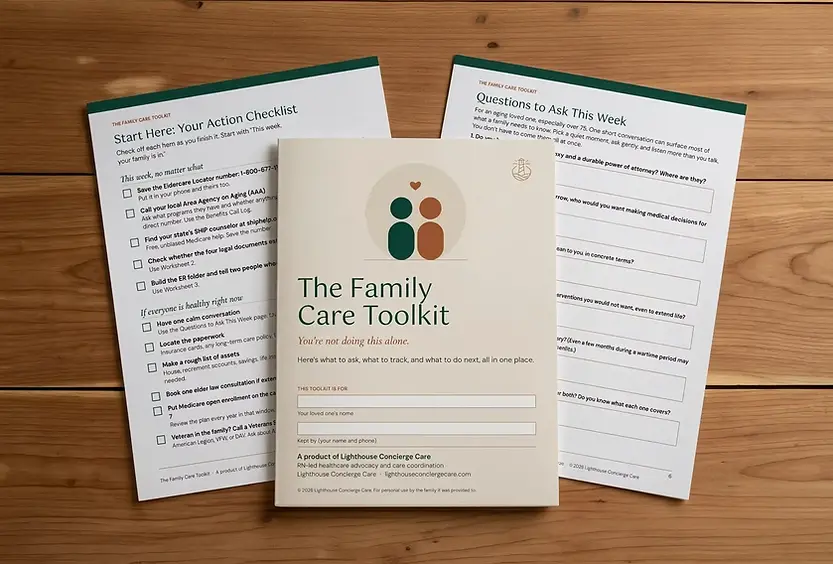
Here is the part most families learn the hard way: the hardest part of getting organized is not the work itself. It is knowing what to ask, what to track, and where to start when you have never done this before. After more than a decade as a nurse and case manager, sitting with families in exactly this moment, I put everything they needed into one place. It is called the Family Care Toolkit, and in this post I will show you the thinking behind it and the first steps you can take today.
Why “just get organized” advice keeps failing families
When I ask families what they have tried, the answer is usually the same. They made a folder, then stopped. They saved a few numbers, then could not find them. They meant to sort out the paperwork, then a diagnosis or a fall moved first.
The problem is not motivation. It is that nobody hands you the map. Which documents actually matter, which questions to ask before a hospital discharge, what a benefits office will want to know when you call, what a hospital needs in the very first minute of an ER arrival. That knowledge usually lives in the heads of social workers, discharge nurses, and case managers. I know, because I was one.
That gap between “I should get organized” and knowing exactly what organized looks like is where families lose time, money, and sometimes decision-making power. Closing that gap is the entire purpose of the Family Care Toolkit I created.
Three things you can do tonight, for free
Because I never want a post to be all take and no give, here are three steps that cost nothing and help no matter where your family is:
Save the Eldercare Locator number, 1-800-677-1116, in your phone and your loved one's. It connects you to your local Area Agency on Aging anywhere in the country, and that office is the front door to most local support programs.
Have one calm conversation this week, over coffee is fine. Ask your loved one where they keep their important paperwork and whether there is anything they have been worrying about that they have not told you. Listen more than you talk.
Put your own doctor's appointment on the calendar, the one you have been putting off. Your health is part of the care plan.
Those three steps will carry you a real distance. What they will not do is tell you what comes after, and that is where the toolkit earns its place.
If you already know your family cannot afford to learn this by trial and error, you can download the Family Care Toolkit now and start with the Start Here page tonight. The rest of this post explains why it works.

What is actually inside the toolkit
I will say it plainly: the worksheets inside are things you could eventually invent yourself, after enough trial, error, and late-night searching. The toolkit exists so you do not have to.
Inside one download you get a step-by-step checklist organized by your family's stage, whether everything is fine right now, things are starting to change, or a hospital stay is happening or likely. There is a page for the paperwork that decides who can speak for your loved one, a grab-and-go medical summary built for the first sixty seconds of an ER arrival, sheets that make doctor appointments and benefits phone calls finally productive, a snapshot of where your loved one really stands day to day, and worksheets for comparing care options and finding the money to pay for them.
Every page asks the questions families do not know to ask, in fill-in-the-blank form, created from more than a decade of RN and case manager experience. It is the conversation guide, the paperwork map, and the calm plan, in one place, for less than the cost of a single copay.
And as a toolkit owner, you also get my full book, What Nobody Tells You About Aging in America, at a discount, with the code included in your toolkit.
Who it is for: the adult son or daughter who has suddenly become the family's medical coordinator. The spouse keeping track of everything in their head. The family member coordinating from another state who wants to be useful from a distance. If you have ever left a hospital hallway holding a folder you did not understand, this was made for you.
A note on timing: Medicare Open Enrollment runs from October 15 to December 7 each year, and a hospital stay, a new diagnosis, or a fall rarely waits for a convenient season. The families who do best are not the ones who avoided trouble. They are the ones who had a plan on paper before trouble arrived.
If you have been carrying the 2 a.m. worry, this is the moment to trade it for a plan on paper. Get the Family Care Toolkit here, print the first page, and begin tonight. Your future self, and everyone who counts on you, will be glad you did.
P.S. If you would rather have an RN walk through it with you, book a Strategic Consultation and we will turn the worksheets into your family's actual plan together.
And if you would like help turning the worksheets into a steady plan, you are welcome to talk to Sonia about a Strategic Consultation. As a registered nurse and Certified Case Manager, I can help you sort through your concerns and identify practical next steps. Sometimes a calm, experienced guide can be the guiding light that helps your family find its way forward.